

Business Research
Building a successful business takes more than being good at what you do.
Most businesses begin with an idea, a skill, or an opportunity. Over time, that business may become much more. It can become a family's primary source of income, one of its largest assets, a retirement strategy, an employer, and ultimately part of a legacy.
But building the business and planning for the business are not the same thing.
Successful business planning requires looking beyond today's revenue and expenses. Taxes, risk management, employee retention, retirement planning, business value, succession, and estate planning can all affect one another.
The question is not simply whether you have a CPA, attorney, financial advisor, or other professionals.
Are they working together toward the same plan?

Is Your Business Building Value Beyond You?
For many owners, years of hard work create a successful business, but success and transferable value are not always the same thing.
If revenue, client relationships, key decisions, or specialized knowledge depend heavily on the owner or a small number of people, the business may be more vulnerable than it appears.
Building long term value means thinking beyond today's income. It means developing people, processes, leadership, financial discipline, and continuity so the business can continue to perform through change.
That matters whether the eventual goal is to pass the business to family, transition it to employees, sell to an outside buyer, or simply create more freedom for the owner.
Start With the End in Mind
For many business owners, the largest financial decision they will ever make may be how and when they eventually leave their business.
Yet exit planning often begins only after an owner has decided to sell, retire, or transfer control. By then, some planning opportunities may already be limited.
The better question is not simply:
“What is my business worth today?”
It is:
“What do I ultimately want this business to accomplish for me, my family, my employees, and my legacy?”
The answer can influence decisions made years before an eventual transition, including business structure, taxes, retirement income, ownership succession, key employee retention, charitable planning, and estate planning.
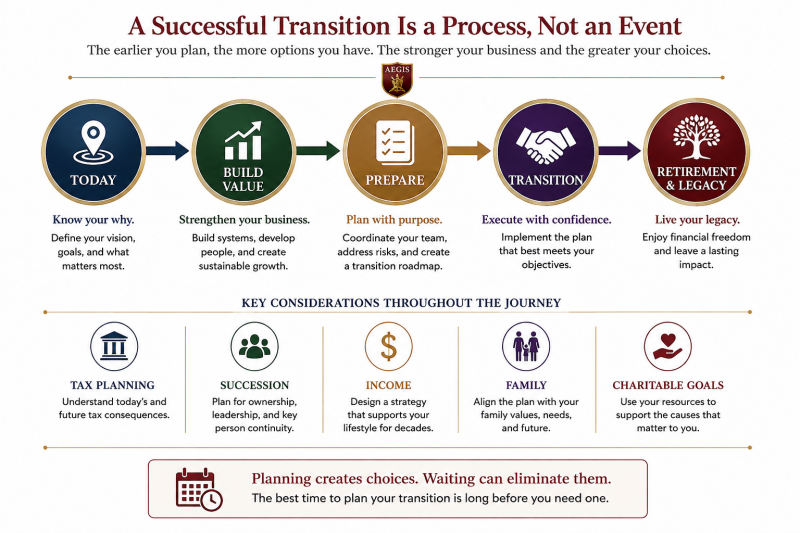
Why Waiting Can Be Expensive
Imagine a business owner who has spent decades accumulating highly appreciated assets. At retirement, the owner decides to sell everything at once. The question isn't whether the sale can be completed. The question is whether years of advance planning might have created additional choices.
What Choices Can Advance Planning Create?
Planning years before a transition does not guarantee a particular outcome. It can, however, give a business owner more time to evaluate alternatives and coordinate decisions across different areas of the financial picture.
Tax Strategy
How and when a business or highly appreciated asset is transferred or sold can have significant tax consequences. Advance planning creates time to evaluate business structure, timing, charitable objectives, and other potential strategies with the owner's tax professionals.
Succession Strategy
Will ownership eventually pass to family, key employees, another business, or an outside buyer? Identifying the desired successor early can influence leadership development, ownership structure, valuation, and financing decisions.
Retirement & Income
For many owners, a substantial portion of personal wealth may be concentrated in the business. Transition planning should consider how that value may eventually be converted into income and diversified resources that can support life after the business.
Estate & Legacy
Business ownership does not end with the business plan. Trusts, estate planning, charitable intentions, beneficiary decisions, and family wealth transfer should be coordinated with the owner's broader financial objectives.
What Happens If the Unexpected Happens First?
Owner & Key Person Risk
What happens if an owner or essential employee dies, becomes disabled, or can no longer work? Revenue, relationships, specialized knowledge, leadership, and even access to financing may depend on a relatively small number of people.
Ownership & Buy Sell Planning
If there are multiple owners, what happens to an owner's interest after death, disability, retirement, or another triggering event? A properly designed buy sell arrangement can establish who may acquire the interest, how value is determined, and how the purchase may be funded.
Protecting & Retaining Key People
A business can have a strong financial plan and still struggle if it cannot attract and retain good people. Compensation, retirement benefits, health and protection benefits, and selective executive strategies can all become part of the broader business plan.
Retirement Plans Are Business Planning Too
A well designed 401(k) can serve both the business and its employees. Plan costs, investment choices, participant education, plan design, and fiduciary processes all deserve periodic review.
Would the plan still work if tomorrow did not go according to plan?
What the Research Shows
Exit Readiness
Research from the Exit Planning Institute shows that business owners have become more aware of exit planning, but significant gaps remain between understanding the need to plan and having a formal transition strategy and advisory team in place. Advance preparation can help owners better align their business, personal, and financial objectives before a transition becomes necessary.
Business Continuity
Succession planning is about more than choosing who will own the business next. Research involving small and midsize family businesses shows that succession involves leadership, family relationships, management capabilities, and preparation for continuity beyond the current owner.
Employee Retention
Benefits can be an important part of attracting and retaining the people a business depends upon. SHRM's 2025 benefits research found employers continue to place particularly high importance on health benefits, retirement savings and planning, and leave benefits when designing their benefit programs.