Investing Research
What does the research tell us about building and maintaining a disciplined investment strategy?
Investing involves more than choosing investments with attractive returns. Here we examine research on diversification, asset allocation, fees, investor behavior, risk, and the principles that can influence long term investment outcomes.
Is Staying Invested Always the Same as Staying Fully Invested?
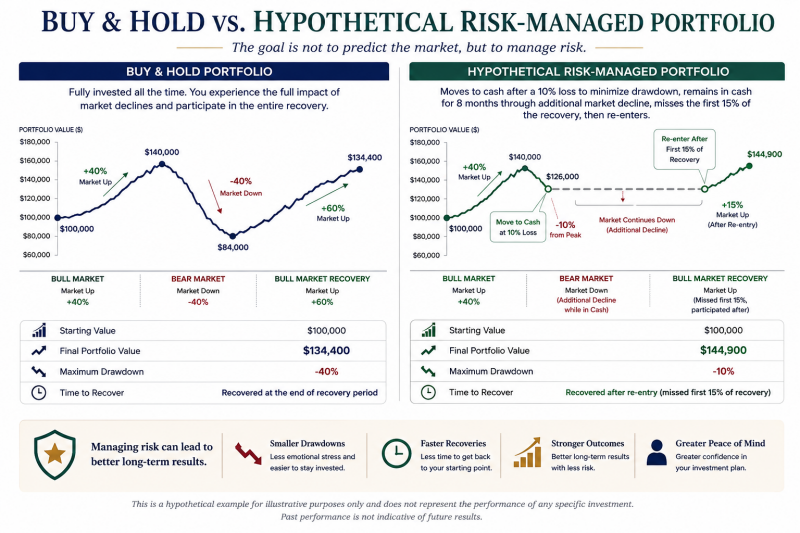
Long term investing requires discipline, but there are different approaches to managing risk along the way. Some strategies maintain a relatively consistent allocation through market cycles, while others systematically adjust exposure as market conditions change. Each approach involves different tradeoffs between participation, risk, drawdowns, and the potential for missed opportunities.
Strategic Asset Allocation
Establish a long term investment allocation based on objectives, time horizon, and risk tolerance, generally maintaining that allocation through market cycles and periodically rebalancing.
Tactical Asset Allocation
Adjust portfolio exposure as market conditions, trends, valuations, or other defined factors change, while remaining focused on longer term investment objectives.
Systematic Risk Management
Use established rules, indicators, or quantitative signals to help guide changes in portfolio exposure rather than relying primarily on emotion or short term predictions.
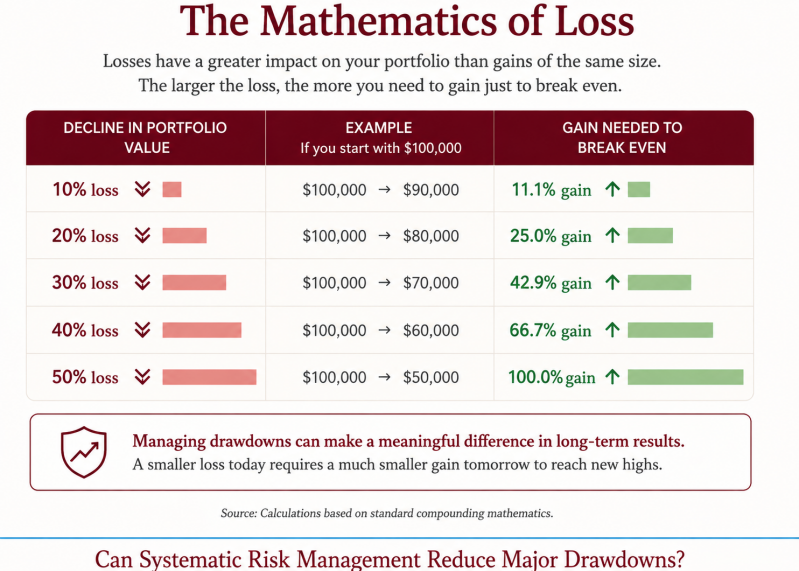
The mathematics explain why limiting large losses can matter. The more difficult question is whether systematic investment strategies can actually reduce major drawdowns without sacrificing too much of the market's long term growth. Researchers have studied this question using trend following, time series momentum, moving averages, and other systematic approaches across different markets and time periods.
What the Research Found
Time Series Momentum
Moskowitz, Ooi & Pedersen
Researchers examined 58 liquid equity index, currency, commodity, and bond futures and found evidence that market trends tended to persist over periods of one to twelve months. Their diversified time series momentum strategy also performed particularly well during extreme markets.
More Than a Century of Evidence
Hurst, Ooi & Pedersen
Using market data extending back to 1880, researchers found positive average returns from time series momentum in every decade studied, with low correlation to traditional asset classes. The evidence suggests that systematic trend following has persisted across very different economic and market environments.
Tactical Asset Allocation
Mebane Faber
Research on a simple quantitative tactical allocation model found that applying systematic trend rules across multiple asset classes historically produced equity like returns with substantially lower volatility and drawdowns. Updated results also examined how the approach performed after the original research was published.
READ THE RESEARCH
The Tradeoff
Systematic strategies do not eliminate investment risk. Reducing exposure during declining markets can help limit some losses, but changing market direction can also produce false signals, additional trading, tax consequences, and periods of underperformance. A strategy that reduces exposure may also miss part of a rapid market recovery.
Buy and Hold vs. Hypothetical Risk Managed Portfolio